
Your shopping cart is empty!
 EN
EN  FR
FR 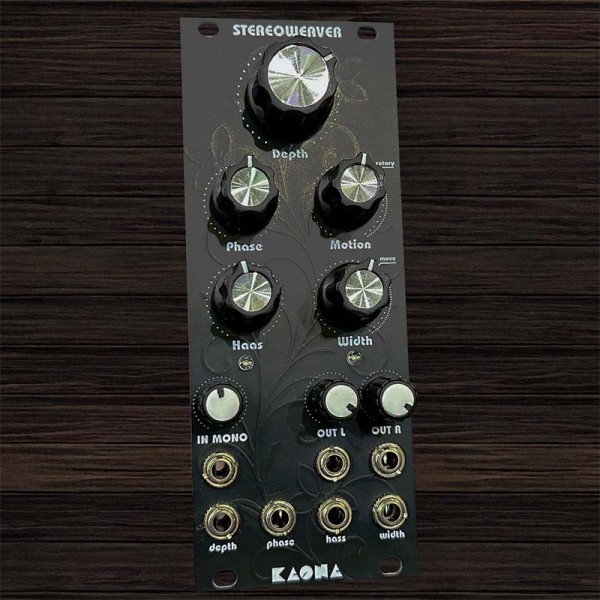
Stereoweaver is a module designed to create and explore a stereo image from a mono source. The processing is based on a combination of depth, micro-delays, and movement. It allows anything from a subtle opening to more pronounced spatial textures, using several approaches: the Haas effect, Leslie-type movement, dynamic phase processing, and panning movement.
Input: mono (Eurorack level)
Outputs: stereo (Eurorack level)
Analog processing on input/output: filtering, attenuation, and amplification for proper integration into a system.
Input gain: adjusts the input level to accommodate sources with different levels.
Clip warning LED: a blinking LED indicates a risk of input clipping. Reducing the input level (or the source level) helps avoid unwanted distortion. It is also possible to intentionally drive the input to use this distortion as a coloration that influences the behavior of the effects.
Independent output levels: separate adjustment of the left and right outputs to balance the stereo image and match the rest of the system.
CV inputs are summed with the settings of the corresponding potentiometers. The modulation amount depends on the potentiometer position (attenuation/amount). CV format: bipolar ±5 V (the CV value is added to or subtracted from the corresponding potentiometer position).
Depth sets the sense of depth and relief of the stereo space, and the amount of effects through the intensity of interactions between the processes:
low: a more direct result;
high: a deeper, more enveloping scene;
toward the end of the travel: micro-chorus and micro-phasing type effects may appear due to phase interactions.
Phase shifts the phase relationship between the channels over a 0 to 180° range, interacting with the other settings. This parameter affects the stability, diffusion, and coherence of the stereo image, as well as its character.
Phase CV: animates this character and changes the spatial color over time.
Motion controls stereo image animation (movement, displacement, spatial modulation):
slow: subtle movement;
fast: more noticeable movement.
Rotary (Leslie): activates a Leslie-type movement with a gradual speed. Two “speakers” (low and high) are simulated, including their speed offset, as well as amplitude and phase variations.
The character of the movement depends on the Depth setting associated with Motion. When Width is in Move mode, Motion sets the speed of the displacement.
The LED associated with Width makes it possible to visualize the movement induced by Motion.
Haas introduces an inter-channel micro-delay to create a sense of space and presence without an echo effect:
moderate setting: natural, clear stereo;
high setting: a more characterful effect.
Transitions of the Haas effect are smoothed by an internal morphing over a few milliseconds, to limit abrupt clipping and distortion. An LED indicates Haas interaction with the signal.
Haas CV: animates the sense of space over time.
Width gradually widens the stereo image while progressively hollowing out the center. An LED indicates Motion’s influence on widening and left/right displacement.
Move (linked to Width): dynamic variation of width and/or stereo placement. In Move mode, the left and right channels progressively exchange their levels at a speed defined by Motion, with an amplitude depending on Phase. At maximum, the displacement becomes more chaotic.
Width CV: animates Width and Move, and changes the stereo scene over time.
Width: 10 HP
Depth: 28 mm
Power consumption: +12 V: 140 mA; –12 V: 20 mA; +5 V: 0 mA
Supplied with mounting screws and power ribbon cable
