
Your shopping cart is empty!
 EN
 FR
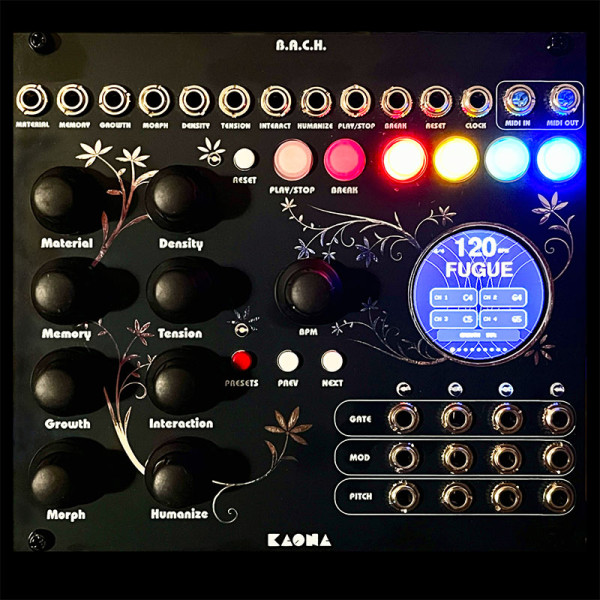
B.A.C.H. generates melodic, harmonic and rhythmic structures in real time. At each clock pulse, it determines the activity of the four tracks, along with their pitches, durations and dynamics. The result is shaped by the selected compositional language and the constraints defined by the musician.
The module controls a modular system directly through its Gate, Pitch and Mod outputs. It can also control MIDI synthesizers and sound modules. Each voice has its own configurable MIDI channel.
FUGUE constructs a multi-voice exposition from a subject, answers, a countersubject and episodes.
CANON develops a leading line through imitation, transposition, delay, contrary motion, retrograde or augmentation.
PROBA uses Markov chains and several transition vocabularies to produce directed randomness.
TINTINNABULI combines a melodic voice with voices whose notes are drawn from a triad or the current chord.
MINIMAL applies gradual processes of phase shifting, addition, substitution and hocketing.
CELLULAR turns the evolution of a cellular automaton into musical material. It provides access to 254 rules.
TREE interprets L-systems and their branching structures as melodic paths.
FRACTAL uses recursive sequences and chaotic systems, including Thue–Morse, Fibonacci, Sierpiński and the logistic map.
MOTIF develops chains of melodic and rhythmic cells drawn from 32 collections.
HYBRID distributes several composition engines across the four voices.
GROOVE organises four rhythmic roles using 64 structures.
GROOVE MIX applies these rhythmic structures to pitches produced by an associated melodic language.
The eight encoders retain the same general function in every compositional language:
MATERIAL selects the vocabulary or initial rule.
MEMORY controls persistence and the rate at which the material is renewed.
GROWTH shapes the development and length of the form.
MORPH introduces rotations, inversions, shifts or mutations.
DENSITY determines the number of events and audible voices.
TENSION gradually moves the material away from its stable state.
INTERACTION organises the relationships between the four tracks.
HUMANIZE introduces performance gestures specific to each language.
Each control has its own CV input. The amount of attenuation can be adjusted individually from the CV IN page.
The MUSIC page provides access to fourteen scales, the root note, overall note duration, several velocity behaviours, ornaments, swing and eight time signatures.
The formal length can be set to 1, 2, 4, 8, 16 or 32 bars. INFINITE mode allows the processes to develop without periodic resets.
The SEQUENCE page can be used to construct a progression of up to 64 positions. Each chord has a relative root, quality, duration and inversion. VOICING mode automatically finds the shortest movement between the four voices.
Twenty-four explicit chord qualities complement the diatonic chord system. Durations range from one beat to eight bars. A library of 96 progressions is included, with 128 user locations available on the SD card.
The BREAK function temporarily alters the composition before returning to the current form. Eight characters are available: AUTO, SILENCE, AGITATION, SUSPENSION, FRAGMENT, PULSE, EROSION and EXPANSION.
The duration can be set to 1, 2, 4 or 8 bars. LIVE mode holds the break until the control is activated again.
Eight CV inputs with attenuation
Dedicated Clock, Play/Stop, Reset and Break inputs
Each track provides:
a GATE output;
a PITCH output following the 1 V/octave standard;
a MOD output for dynamics.
The Pitch outputs cover eight octaves, from 0 to 8 V. The Mod outputs cover a range of 0 to 5 V.
The MIDI input can receive clock, transport commands, notes used to change the root note, and continuous controller messages. A Learn mode simplifies MIDI controller assignment.
The MIDI output transmits the four voices over independent or shared channels. It can also send transport commands, a 24 PPQN clock and an expression envelope.
The CV Clock input expects one pulse per quarter note. The module can run from its internal clock, follow the CV Clock input or synchronise to MIDI clock.
B.A.C.H. automatically retains its most recent state. The SD card provides 128 preset locations. Each preset stores the selected language, the eight control settings, musical parameters, CV attenuation settings, MIDI settings, Break configuration and the complete harmonic progression.
Width: 28 HP
Depth: 28 mm
Power consumption: +12 V: 240 mA; −12 V: 40 mA; +5 V: 0 mA
MIDI: TRS Type B for input and output
Supplied with a power cable, mounting screws, two TRS Type B adapters and an SD card pre-installed in the module
Calibrated before shipping

